The city above La Paz
El Alto and its cholets
El Alto, the high city where the wrestling happens, and the colourful cholet buildings that give it a skyline unlike any other, with the architect behind them.
Reserve a seat at the ring ↗The city above La Paz
El Alto is the second-largest city in Bolivia and sits on the Altiplano, right beside La Paz. Its name is Spanish for the high one, and its Aymara name is Patamarka. It stands at an average elevation of around 4,000 metres, which makes it one of the highest major cities in the world. A steep slope several hundred metres high separates the two cities, and a cable car network now links them. The wrestling shows in this guide take place here, not in central La Paz.
How a rail yard became a city
For centuries the plateau above La Paz was a dry plain with few people. That changed in 1903, when the railway from Lake Titicaca and Arica reached the rim of the canyon and a settlement of railway workers grew up around the terminus. An airfield followed in 1925. Growth took off in the 1950s, once the settlement was connected to La Paz's water supply. In 1985 El Alto was politically separated from La Paz, and in 1987 it was formally incorporated as a city. Migration from rural areas keeps it growing.
A high, cold city
The climate matches the altitude. Days are cool, nights are crisp year-round because the thin air holds little heat, and snow is possible at any time of the year. That is why the booking advice for the wrestling nights is to bring warm clothes: El Alto is colder than central La Paz, especially after sunset. It is also why a hall that looks bright and festive from the outside can be cold inside.
What a cholet is
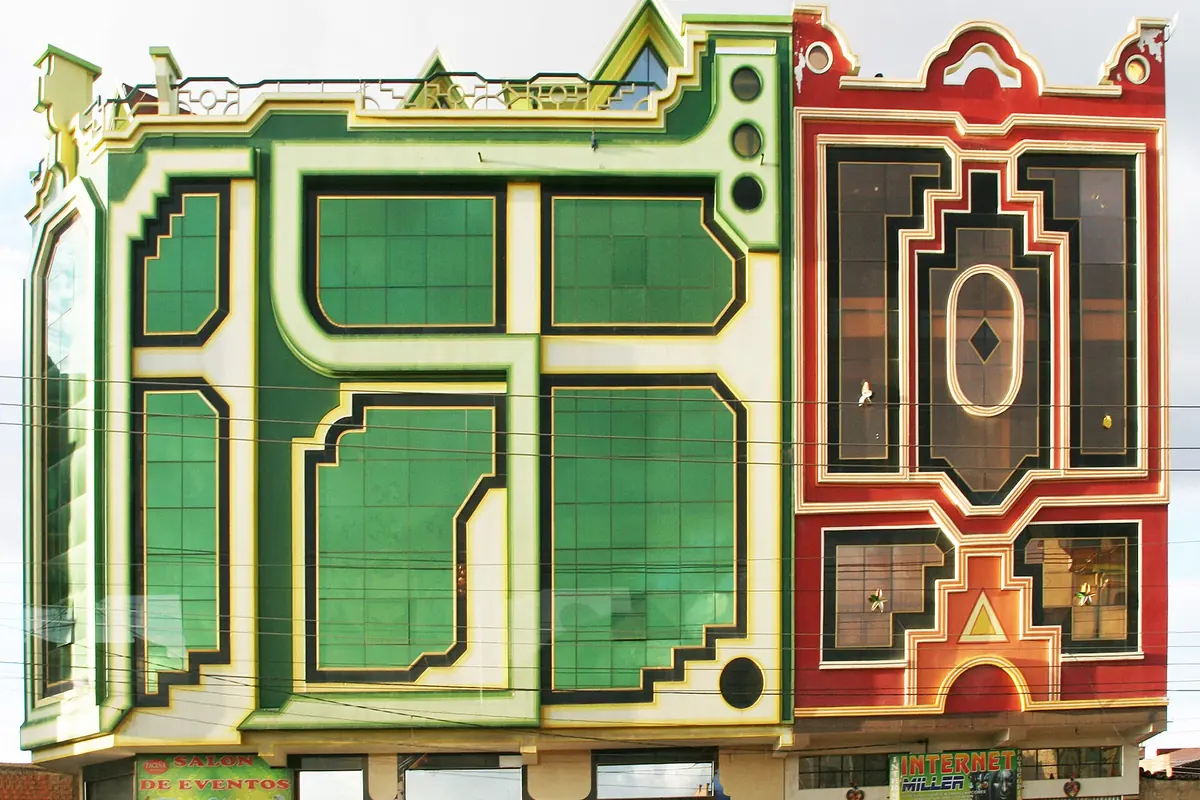
A cholet is a building in the Neo-Andean style, and the name blends cholo with chalet. It is part mini-mansion, part event space. The lower floors often hold shops, and the upper floors are often used as party spaces. Cholets are concentrated in El Alto, and more than a hundred buildings in the style stand along its skyline. Their facades are big, bright and geometric. They emerged alongside a modest economic boom and growing Aymara pride, and the first was commissioned by a local businessman.
The architect behind them
The style is closely tied to Freddy Mamani, a self-taught Bolivian architect born in 1971. His father was a bricklayer, and he worked as a bricklayer himself. The family moved to El Alto when he was six, and he later gained degrees in civil construction and engineering. He wanted to become an architect but could not fit university classes around his work. His first building in the style was commissioned in 2002 and finished in 2005. Since then he has designed dozens of buildings in El Alto, and National Geographic has written about his work.
Colours and patterns
The facades borrow their colours from traditional Aymara fabrics, including the awayo shawls women use to carry children. The forms draw on Andean art, such as the Andean cross, repeated shapes and diagonal layering, and some describe the mix of straight lines and curves as chacha-warmi, the masculine and the feminine in balance. Residents are generally pleased with what these buildings add to the city, and one has described them as a shout that says here we are. The look is deliberate, a way of announcing who you are.
Wrestling in a ballroom
On some days the cholitas wrestling show is held in one of these cholet-style event halls, where a hall built for parties is turned into a wrestling arena for the evening. It makes sense: the buildings were designed for crowds, noise and celebration, and the wrestling nights bring all three. If your booking takes you to one, look at the facade, the entrance and the room before the first bout. It tells you as much about modern El Alto as the show does about the cholitas.
Seeing more of El Alto
Three cable car lines connect El Alto with central La Paz, and the ride shows how the city looks from above. El Alto also has a large open-air market and an art museum, and it is known for its Neo-Andean architecture, built from the mid-2000s onward. Do not treat it as a district to wander at night on your own: the World Travel Guide advises against exploring El Alto alone after dark. An organised outing gets you to the show and back, and leaves the street-level sightseeing for daylight.
Sources