The women and their dress
Who are the cholitas?
The women of the pollera: where the layered skirt, the small bowler hat and the aguayo come from, and how a once-hated word became a source of pride.
Reserve a seat at the ring ↗Women of the pollera
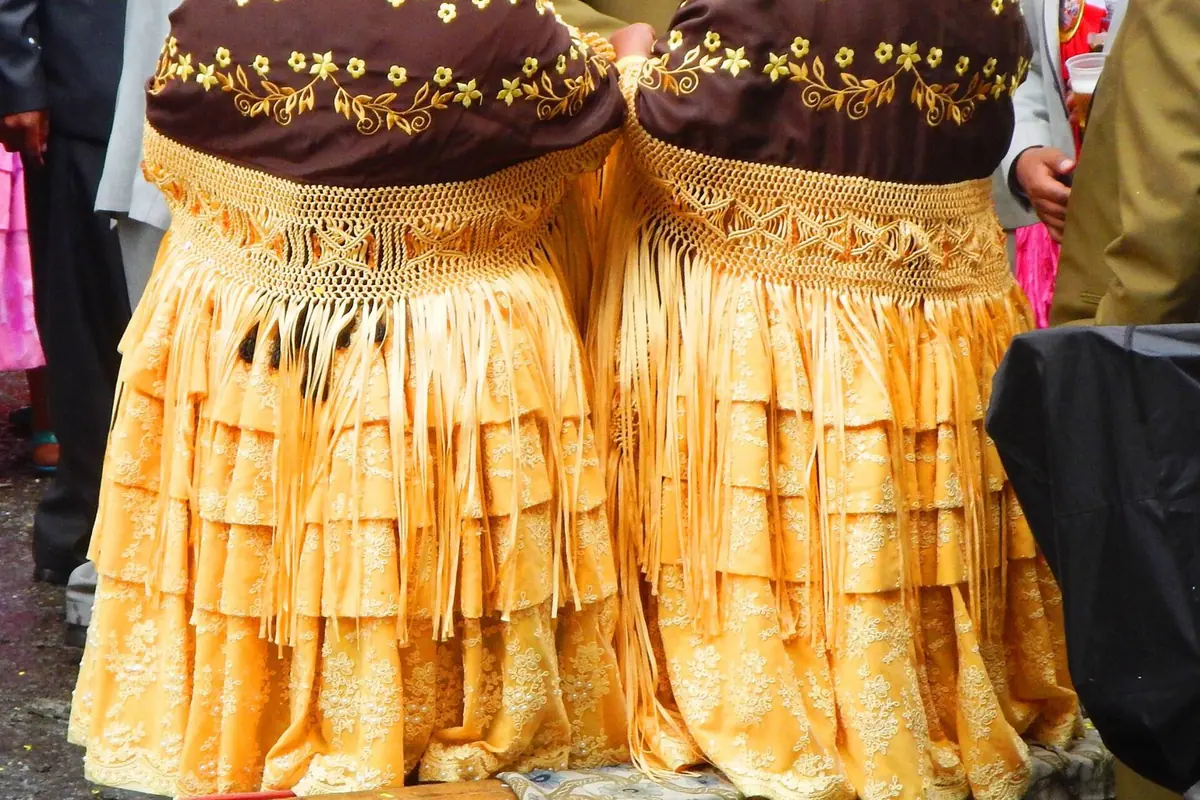
In Spanish they are mujeres de pollera, women of the pollera. They are Andean women whose culture sits between the urban mestizo world and the rural Indigenous one, mostly Quechua and Aymara, and in some places Afro-Bolivian. Their dress is distinctive: a wide pollera skirt over layered petticoats, two pleated braids, and a shawl. Chola and cholita are the older words for them, and both began as insults. In Bolivia many women have taken the words back, which is why the cholitas who wrestle use them with pride.
How the dress came about
The dress has a colonial origin. The mixed-race caste of cholos was introduced after the Spanish conquest of the Inca Empire in the 16th century. After the great rebellions of the 1780s, native customs were strictly banned. Cholas were ordered to wear Spanish-style clothing, and the women of La Paz, Oruro and Potosí were told to follow the folk dress of Extremadura. Women in other regions were told to dress in Andalusian peasant clothing. Women kept and reshaped the imposed clothes over generations until they became their own.
What the pollera is
The pollera is worn over one or more petticoats called enaguas, and with enough of them it forms a bell shape like a hoop skirt. A sweater or blouse goes on top, then a shawl held with a pin, and an apron over the skirt. Hair is worn in two braids down the back. The skirt is why a cholita wrestler's silhouette is unmistakable in the ring. A fuller skirt is generally considered better, and the details of the outfit vary from region to region.
The bowler hat
The bowler hat, the bombín, is the typical hat of pollera women in La Paz, Oruro and Potosí. Italian-made hats were first marketed in the Altiplano in the late 19th century. In La Paz the hat is small and sits on top of the head instead of fitting snugly, so the wearer has to balance it. A popular story credits a hat seller with selling a shipment of undersized hats to women in the 1920s. Another popular belief reads the position of the hat as a signal: a straight hat for a married woman, a cocked hat for a single one.
The aguayo and the tullma
The aguayo is a woven cloth worn across the shoulders. Women use it to carry goods or a child, or as a swaddle. The tullma is a beaded hair ornament traditionally made from llama or vicuña hair and woven into the braids. In La Paz, women prefer natural tones. Both objects show why a pollera outfit is more than a skirt and a hat: each piece has a job, and many carry a meaning that varies from region to region.
From exclusion to heritage
For much of the 20th century pollera women faced exclusion. Even after the 1952 revolution, urbanising pollera women were banned from public spaces such as Plaza Murillo and often refused service in shops, buses and taxis. By the 1970s many worked as street vendors or migrant workers. Things changed after 2005. Discrimination against pollera women was banned by the 2010 Law Against Racism, and in October 2013 the city of La Paz declared the chola paceña part of its intangible cultural heritage. A pageant, Cholita Paceña, now includes folk dance and Aymara-language demonstrations.
Beyond the ring
The wrestlers are not the only women using the pollera in sport and public life. Cholita climbers climb mountains in the skirt, and a skateboarding club in Cochabamba skates in it. In 2013 the city of El Alto hired cholas as traffic police in traditional dress. Pollera women have entered law, government and journalism since the 2000s. Among them are a president of the constituent assembly, a celebrity chef and a journalist. Groups like these say they stand for cultural heritage and the empowerment of Indigenous women, and the wrestlers share that aim.
Seeing the dress at the show
At a cholitas wrestling show the dress is the first thing you notice and the last thing you should take for granted. In the ring you see the pollera, the braids and the shawl. The performers are described removing hats, shawls and jewellery before a bout, so what you watch is the skirt and the blouse. Ask yourself what each piece means to the woman wearing it. A guide or host can explain, and the digital guide that comes with some bookings includes interviews with the wrestlers and founders.
Sources