Getting there
Cable car to the cholitas show
How the Mi Teleférico cable car links La Paz and El Alto, why some days of the booking use it and others use a bus, and what the ride shows you.
Reserve a seat at the ring ↗Two ways up to El Alto
The show is in El Alto, and El Alto sits above La Paz. The booking handles the climb in one of two ways, depending on the day of the week. On some days the group travels by cable car and then continues by private transport. On other days a private bus does the whole trip from central La Paz. Either way, transport both ways is part of the booking. Which one you get is set by the day you choose, so you cannot pick the cable car on a bus day.
What Mi Teleférico is
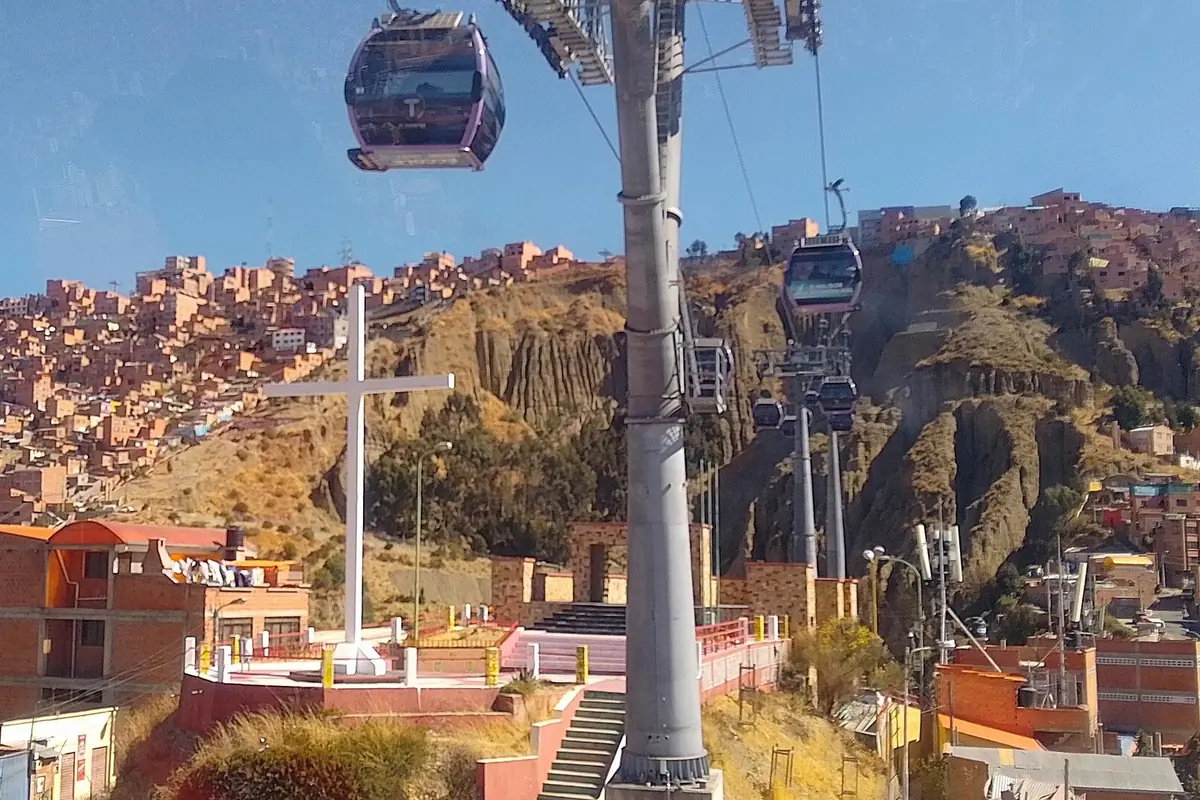
Mi Teleférico, My Cable Car, is an urban cable car system that connects La Paz and El Alto. It is run by a state company and opened in 2014, and it has grown since. Its lines are named for colours, and several of them link the two cities. One account calls it the longest aerial cable car system in the world, and another describes La Paz as having the largest urban cable car network. Whatever the ranking, it is a working transit system, not only a view.
Why it exists
The two cities are separated by a steep slope several hundred metres high. Before the cable car, travel between them was slow and congested, which cost people time and money. The network was built to relieve that pressure, along with traffic and pollution, and the demand for subsidised fuel. For visitors the effect is simple. A trip that once meant a long road climb is now a ride in the air, and the cabins serve residents' daily travel as much as visitors.
In the cabin
The system uses monocable gondolas. Each car seats ten passengers, so a group usually shares a few cabins. You travel past roofs, hillside streets and viewpoints that are hard to reach by road. Keep your coat on, because the Altiplano is cold, and carry a camera or phone that you do not mind holding at the window. If you are afraid of heights, ask about the day's transport before you book.
What you see
The ride shows the shape of the metropolitan area: a deep valley of dense houses, with El Alto as a plateau at the top. On a clear day snow-capped peaks of the Cordillera Real stand on the horizon, as in the photograph on this page. The ride also gives you a sense of scale. La Paz climbs the valley sides, and the colourful buildings of El Alto, the cholets, wait at the rim. Look out for them as you rise, and notice how the city changes in the first minutes.
Read next: El Alto and its cholets
On the way back
After the show a private bus returns the group to central La Paz, with a final stop in the San Francisco area. The return is by bus on cable car days too. If you have a night bus out of the city, tell the operator in advance, because a drop-off near the main bus terminal may be possible when operations allow. The altitude guide has the rest of the planning, including what to wear for the cold and what cash to carry.
Read next: Cholitas show: altitude and cold
Central La Paz before you leave
The meeting point is in central La Paz, and operators choose different ones. One meets at a café in the downtown area. Another uses an office between the Witches' Market and the San Francisco Church, in a busy tourist area. The Witches' Market, one of the city's renowned markets, sells herbs, remedies and ingredients used in Aymara traditions. If you arrive early, a short look around is easy, but keep your eye on the time and leave enough margin to reach the meeting point a few minutes early.
If heights are a worry
The cable car is part of the trip only on certain days. If heights bother you, or if you simply prefer a road to a cable, choose a day on which the operator uses a private bus, and check the confirmation. If you are comfortable with heights, the cable car gives you a view of La Paz and El Alto from above, which guests often mention. Ask the host about the plan for your day. The host speaks English and Spanish and can tell you which transport your booking uses.
Sources